Monitoring: Do you need an area assessed for bat activity?
|
Dr. Cori Lausen [left] and colleagues from the University of Calgary [including Erin Baerwald, right] produced the first North American protocol for bat activity assessment in the pre-construction phase of wind farm development.
Photo by R. Barclay
Newer, taller wind turbines seem to be killing more bats than the older style turbines [Barclay et al. 2007]. Strategic placement of new wind farms may reduce bat mortality. Pre-construction monitoring for bats can help determine whether a proposed wind farm location is in the migratory path of bats. After turbines are built, post-construction monitoring is necessary to determine bat mortality rates. Mitigation strategies include shutting turbines down in low wind speeds.
Acoustic techniques are still the most effective tool for pre-construction monitoring; while radar can be useful for counting objects flying in a wind development area, bats and birds are not easily distinguished. While habitat features can be useful for determining potential hibernation and maternity sites, bat migration routes are difficult to predict. The wind farms pictured here in SW Alberta have higher bat mortality rates than turbines further east in that province. Crop fields don't look like typical bat habitat, which makes pre-construction acoustic survey critical..
|
Acoustic Analysis: Do you need acoustic files analyzed?
|
Analysis of bat acoustic files is an acquired skill. Bats are not birds. In other words, their calls are not designed to be species specific to attract mates; instead they are functional, designed to catch insect prey. Bats of similar body size that feed on similar sizes of insects can have very similar echolocation calls. And there is a great deal of plasticity in echolocation calls, allowing bats to change their echolocation call structure to best suit their surroundings. For example, near trees, an individual bat will produce a different call structure than when it is foraging in an open field. As such, only after examining many recordings of bats flying in varied environments, can one most confidently differentiate species. And even then, some species of bats are very difficult and sometimes impossible to tell apart 100% of the time. As automated call analysis becomes available, it will be important that results be interpreted with an appropriate level of skepticism, such that species identifications and probabilities are not blindly accepted.
Birchdale Ecological Ltd. offers training sessions in how to analyze your own calls, but encourages all students to acquire experience following training. Not enough time to invest in learning, or unable to analyze enough files each season to become proficient? I will analyze your files for you. I have extensive experience in zero-crossing (Anabat) and full spectrum data analysis.
|
|
Survey:
Do you need a bat survey conducted?
|
Capture and detection probabilities are different among species, necessitating the use of both survey techniques. How and where mistnets are deployed can severely bias species capture ratios. For example, in the Pacific Northwest, mistnetting over standing water will result in a high capture bias of little brown bats, while netting in cluttered forest trails will bias captures to long-eared bats and California Myotis. Nets low to the ground have less of a chance of catching high-flying species such as big browns, hoary bats, red bats and spotted bats.
As White Nose Syndrome continues to spread in North America, it is becoming evident that there is a limited amount of time in which to conduct surveys in western North America, where WNS is not currently known. Many areas in western North America have yet to be surveyed to determine bat biodiversity.
Photo above by J. Hardisty
Wish to do your own capture surveys? I can provide training in bat capture and handling. Pre-exposure rabies vaccinations are required.
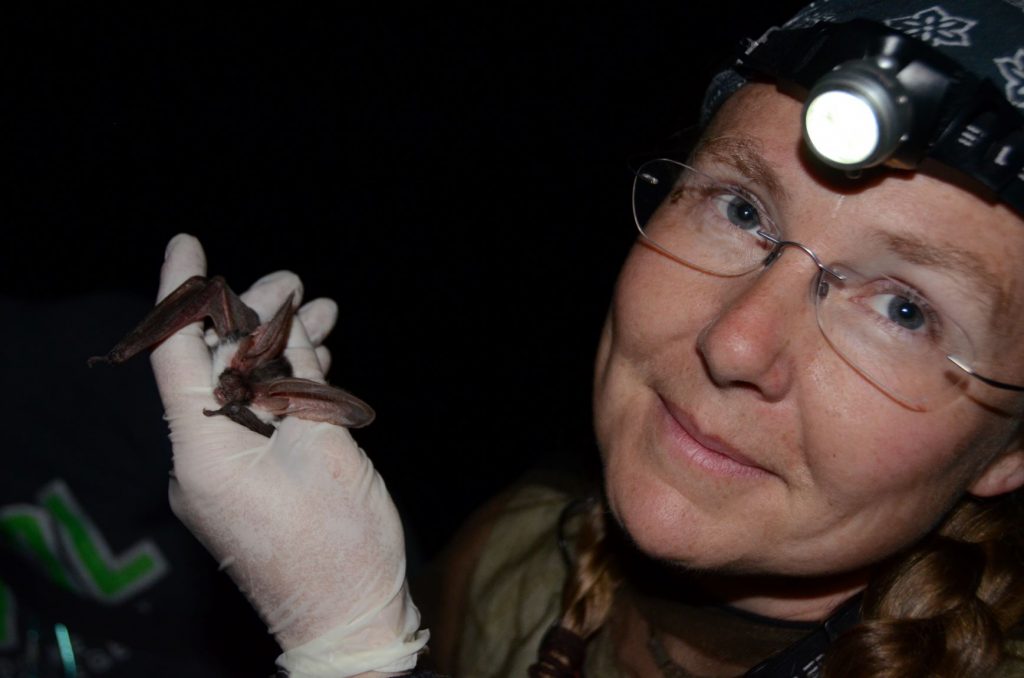
Photo above shows Cori measuring a bat in Nahanni National Park, NWT. In 2006, she conducted the first large scale bat survey in the Northwest Territories, increasing known species from 3 to 7.
|
Bats play an important role in ecosystems; they are the only major consumer of night-time insects; they are critical pollinators in some areas, seed-dispersers in others; and more.
There are vast regions around the globe that remain unsurveyed for bat biodiversity. Despite the fact that bats comprise more than one quarter of all mammal species [there are >1000 species of bats world-wide], much remains unknown about these naturally cryptic creatures. Baseline species diversity information for many areas of North America is lacking, and is likely to change dramatically with climate change; documenting biodiversity and following changes in species ranges requires formal surveys.
Photo by G. Foli
|
Fundamental to conservation of biodiversity is knowing what species exist in an area!
Top of Page
|
|